We’re starting the process of moving from Blackboard Class Collaborate to Microsoft Teams, and we’d really value your input. In its place, we’ll be supporting the Microsoft Teams integration within Blackboard as the primary tool for online teaching, tutorials, and live sessions.
Many of you are already using Teams for learning and teaching and we’d like to hear more about your experiences so far. To help us understand what’s working well (and what isn’t), we’ve put together a short questionnaire. Your feedback will play a key role in shaping the support, resources, and training we provide over the coming months.
Thank you for taking a few minutes to share your thoughts.
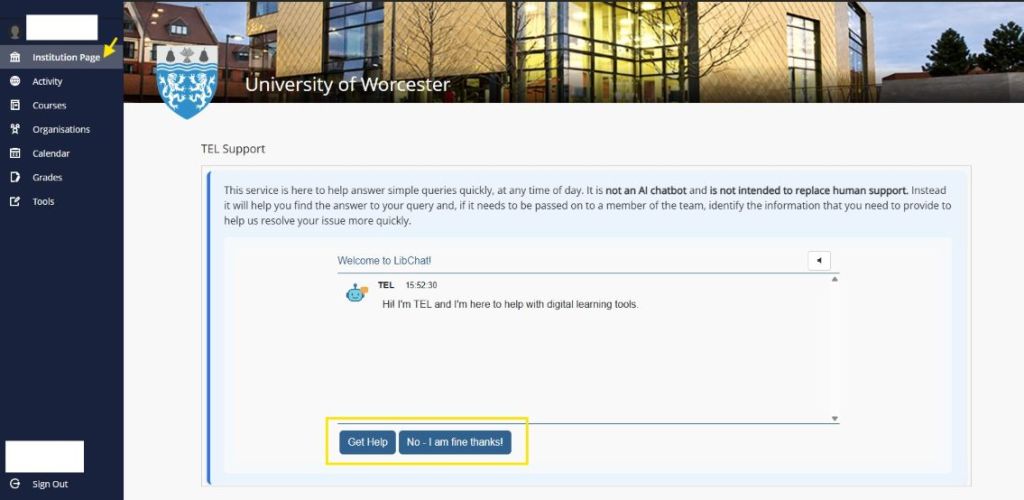
We know that many student queries sent to academic staff relate to learning technologies rather than module content – things like accessing tools, submitting work, or understanding how a platform works. To help streamline this, the TEL team has launched a new TEL Chatbot, designed to give students fast, reliable answers to common questions.
The chatbot is not AI-driven and doesn’t generate responses. Instead, it draws on a curated set of frequently asked questions and approved guidance from the TEL team, ensuring that students receive clear, accurate and consistent information. It’s available 24/7 and acts as a helpful first point of contact for common TEL-related queries.
You’ll find the TEL Chatbot on the institution page in Blackboard, making it easy for students to access whenever they’re working online.
How this helps you
Reduces repeat queries landing in your inbox
Gives students immediate answers to common TEL questions
Ensures advice is accurate and up to date
Frees up time for more complex or academic-focused support
What we’re asking of you
When students contact you with questions about learning technologies, we’d really appreciate it if you could direct them to the TEL Chatbot in the first instance. It’s designed to handle the most common issues and will point students to the TEL team where further support is needed.
You might also want to:
Mention the chatbot in Blackboard announcements
Highlight it during early teaching sessions
Add a brief note to module information or FAQs
The TEL Chatbot won’t replace human support – but we hope it will become a reliable first stop.
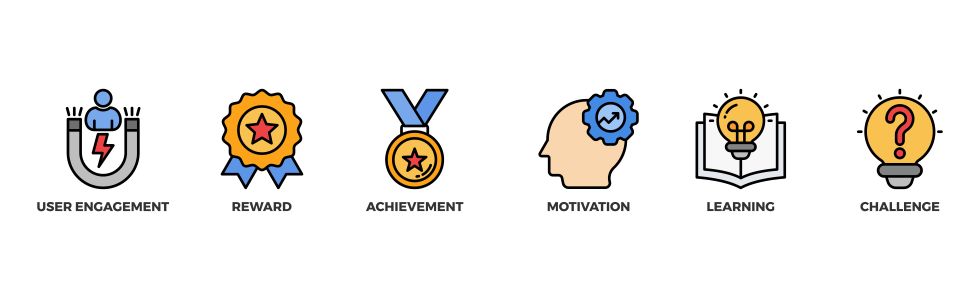
Research shows gamification can genuinely support learning. Dichev and Dicheva’s (2017) Gamifying Education PDF highlighted how small, game-like elements such as quick feedback, progress cues and low-stakes challenges can encourage greater student participation. A recent 2024 meta-analysis by Diaz and Estoque-Loñez reviewed 15 studies and found consistent improvements in learning achievement when gamified approaches were used (Meta Analysis PDF); reinforcing that well-designed, gamified strategies can have broad benefits.
Want to try it?
Vevox, the University’s live polling and Q&A tool, is running short, practical training sessions throughout January and February to help you get started.
What you’ll learn
How to run polling, plus an overview of Q&A and Surveys
A walkthrough of the PowerPoint add-in, letting you run polls directly from your slides
Practical ideas you can use straight away to build interaction and check understanding
Sessions run weekly at a range of times, so you can choose whatever works around your timetable.
You can register for the webinar by clicking this link:registration link
As the nights draw in and the days get shorter, it is a good time to consider your digital wellbeing. Online and hybrid teaching has blurred boundaries between work and home – classrooms now stretch into kitchens, buses, and home offices. But being constantly connected doesn’t make us more effective. For staff and students, an “always-on” approach can quietly drain focus, energy, and wellbeing. UK research shows students can experience increased ‘technostress’ linked to messaging and app use in learning contexts ( Biggins & Holley, 2023 https://eprints.bournemouth.ac.uk/37700/).
Even short digital tasks can become overwhelming. Some common challenges include:
· Frequent notifications from Teams, email, or Blackboard.
Academic work can easily blur into personal time. Setting clear expectations helps model healthy digital habits:
· Add a note to your module: “I check discussion boards weekdays 09:00–17:00. Responses may take 24 hours.”
· Use Teams/Outlook quiet hours and tell students you do – it normalises offline time.
· Turn off push notifications after hours; your brain will thank you.
Design for Digital Calm
A cluttered digital space can feel as stressful as a messy desk.
· Keep navigation simple and avoid too many layers of folders and subfolders.
· Limit announcements and emails to essential information only.
· Hide old modules on your Blackboard dashboard to reduce “digital noise.”.
· Make content accessible: uAlt-text, captions, and consistent layouts help everyone (Lister et al., 2022: https://oro.open.ac.uk/84158/).
Connecting to the Bigger Picture
Jisc’s Digital Wellbeing for You, Your Colleagues and Learners (2024) reminds us that digital wellbeing isn’t just about screen time, it’s about creating environments where technology supports rather than overwhelms. Their guidance encourages staff to build in moments of digital calm by simplifying online spaces, supporting balance, and modelling positive digital habits. You can explore the full guide here: Jisc Digital Wellbeing for You, Your Colleagues and Learners (PDF)
Top Tips for Digital Wellbeing
(Based on Jisc’s 2024 Practitioner Guidance)
Be intentional – Pause before you click. Choose tech and tools that serve your purpose, not the other way round.
Set boundaries – Ditch the “always-on” culture. Turn off notifications and protect offline time.
Mind your body and mind – Take screen breaks, move regularly, use blue-light filters, and notice when tech is draining rather than supporting you.
Shape your digital self – Review your online profiles and platforms. Make sure they reflect the professional (and person) you want to be.
Share the load – Digital wellbeing is a team effort. Talk openly with colleagues and students about healthy digital habits.
Personalising your profile on Blackboard Ultra goes beyond aesthetics—it plays a crucial role in creating a more engaging and interactive learning environment for your students. Here’s why you should invest time in customising your profile.
Building Connections
A personalised profile humanises the online learning experience. By adding a photo and personal details, you create a sense of familiarity and approachability, making it easier for students to connect with you.
Enhancing Communication
When students see a face behind the messages and instructions, it fosters better communication. A customised profile picture and relevant information can make your announcements, feedback, and interactions more impactful.
Establishing Credibility
A well-crafted profile demonstrates professionalism and commitment. Including your academic background, teaching philosophy, and relevant experiences can enhance your credibility and authority as a educator.
Encouraging Engagement
Profiles that reflect your personality and teaching style can inspire students to be more active and engaged. Sharing a bit about your interests and teaching methods can make your courses more relatable and interesting.
Streamlining Identification
In large classes, a recognizable profile helps students quickly identify you in forums, discussions, and course materials. This streamlined identification process is important for maintaining effective communication and support.
Promoting Inclusivity
Including your pronouns and preferred name in your profile fosters an inclusive and respectful learning environment. It signals to students that you value diversity and individual identity.
Conclusion
Personalising your Blackboard Ultra profile is a simple yet powerful way to enhance the educational experience for your students. It fosters better connections, improves communication, and creates a more engaging and inclusive learning environment.
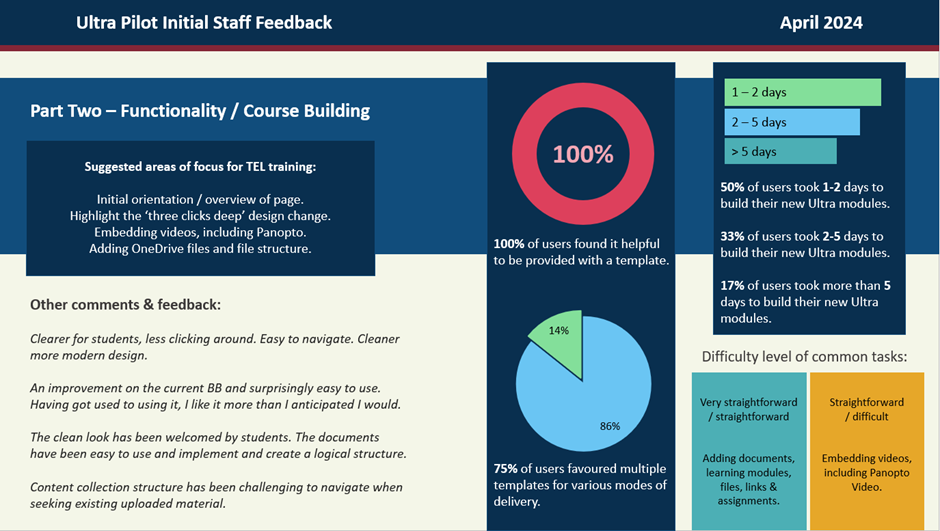
January saw our Ultra pilot users embark on their new VLE journey. The users were spread across a range of courses with varying modes of delivery, and the TEL team have enjoyed the opportunity to discuss pedagogical considerations, as well as more routine, ‘how do I do that?’ questions. After creating their modules, we asked the pioneers for feedback which is summarised on the images below:
Next Steps
We are using this feedback to guide the broader implementation of the new ‘Blackboard Learn Ultra’ VLE for the wider organisation. Additionally, it will help to inform the training provided by TEL, the customisation of templates, and the system, where feasible.
We are now working with senior colleagues in schools, to offer dedicated workshops for schools and departments, which will begin at the end of April and will continue through into the summer. Check with your teams for further information.
Following a pilot last year, the University has partnered with GoodCourse to develop and deliver a range of micro-learning courses for all students. These courses take around 5 minutes to complete are designed to mimic the feel of the social media apps.
What is micro-learning?
Micro-learning, as the name suggests, is learning delivered in tiny segments. Courses are highly-focused, distilling complex ideas into simple concepts. This allows them to be completed in minutes and makes them very convenient.
In our pilot and other studies it’s proven to be an effective way to share knowledge and embed learning. Courses use a combination of different media, including:
Short accessible videos
Text and images
Audio
Pop-quizzes
Watch this video for a 2-minute overview:
How will it be delivered?
A text message is sent to students’ phones, it briefly explains the course and how long it will take then encourages them to tap a link. The link takes students to the GoodCourse platform, which has been optimised for mobile – but also works on tablets, laptops and PCs.
The platforms tracks completion rates and allows reminders to be sent if a course is not completed.
What MicroLearn courses will run this year?
In 2023/24 we plan to run MicroLearn courses on the following topics:
Welcome to Worcester – planning for study
Sexual misconduct and consent
Planning for an A
We are working on courses for a range of other topics, which we hope will be available later in the academic year.
It will soon be time to say goodbye to your students, but this does not mean that they need to leave all of their university life behind. Students are entitled to a free Pebble+ Alumni Account, enabling them to take their portfolios and assets with them.
Information on how to do this can be found here but should not be followed until the course is completely finished – once the institution account is converted to an alumni account, it cannot be reversed.
With courses now in full flow, it is a good time to for a quick reminder on how to set up a Turnitin submission point. This is just an overview; further information and step by step instructions can be found on our website.
What is the process?
Turnitin submission points are created via the ‘add content’ option on Blackboard. At this point you can add the assignment name, instructions, maximum grade and the relevant dates.
Clicking on the‘Optional Settings’ will bring up additional tick boxes to customise the assignment to fit with University protocols. If you are unsure what any of the options mean, hover over the question mark icon and an additional text box will pop up to give clarifcation.
A newer feature that you may wish to use is the grammar checker. By ticking this option an additional report will be generated that allows you to view any grammatical errors in the submission. More information about this feature can be found here.
Rubrics
Before you save your submission point, you may wish to add a Rubric. These are completely optional and provide quick way of adding standardised feedback. Further information about how to import a rubric can be found here.
Ready to go
Your submission point is now ready to go and will appear as a link in Blackboard.
Things to remember
Students can resubmit work to the submission point as many times as they like until the due date.
After the 3rd upload, there will be a delay of 24 hours until the similarity report is received.
Once the due date has passed they will be unable to submit again.
Resubmissions, resits and mitigating circumstances will require a new Turnitin submission point.
Before you begin grading you will need to hide the Blackboard Grade Center column from students – otherwise they will be able to access their grades as soon as they have been entered. Instructions can be found here
Grades and feedback are automatically released to students on the Feedback Release Date and time through Turnitin.
We use cookies on our website to give you the most relevant experience by remembering your preferences and repeat visits. By clicking “Accept All”, you consent to the use of ALL the cookies. However, you may visit "Cookie Settings" to provide a controlled consent.
This website uses cookies to improve your experience while you navigate through the website. Out of these, the cookies that are categorized as necessary are stored on your browser as they are essential for the working of basic functionalities of the website. We also use third-party cookies that help us analyze and understand how you use this website. These cookies will be stored in your browser only with your consent. You also have the option to opt-out of these cookies. But opting out of some of these cookies may affect your browsing experience.
Necessary cookies are absolutely essential for the website to function properly. These cookies ensure basic functionalities and security features of the website, anonymously.
Cookie
Duration
Description
cookielawinfo-checkbox-analytics
6 months
This cookie is set by GDPR Cookie Consent plugin. The cookie is used to store the user consent for the cookies in the category "Analytics".
cookielawinfo-checkbox-functional
6 months
The cookie is set by GDPR cookie consent to record the user consent for the cookies in the category "Functional".
cookielawinfo-checkbox-necessary
6 months
This cookie is set by GDPR Cookie Consent plugin. The cookies is used to store the user consent for the cookies in the category "Necessary".
cookielawinfo-checkbox-others
6 months
This cookie is set by GDPR Cookie Consent plugin. The cookie is used to store the user consent for the cookies in the category "Other.
cookielawinfo-checkbox-performance
6 months
This cookie is set by GDPR Cookie Consent plugin. The cookie is used to store the user consent for the cookies in the category "Performance".
viewed_cookie_policy
6 months
The cookie is set by the GDPR Cookie Consent plugin and is used to store whether or not user has consented to the use of cookies. It does not store any personal data.
Functional cookies help to perform certain functionalities like sharing the content of the website on social media platforms, collect feedbacks, and other third-party features.
Performance cookies are used to understand and analyze the key performance indexes of the website which helps in delivering a better user experience for the visitors.
Analytical cookies are used to understand how visitors interact with the website. These cookies help provide information on metrics the number of visitors, bounce rate, traffic source, etc.
Advertisement cookies are used to provide visitors with relevant ads and marketing campaigns. These cookies track visitors across websites and collect information to provide customized ads.