Training

Recording in-class presentations for assessment

Three people: one with a camera recording the person in the centre. the third person holds a director's megaphone.

Recently we have seen an increase in queries about recording student presentations for assessment. As ever, a Blackboard submission that uses Panopto is the best option for student submissions. However, what about recordings for presentations in-class? There are a couple of options available.

Manual recording

This is the method that most staff have used historically. Many schools have their own video cameras, and staff can borrow these to record the student presentations and share with external examiners via OneDrive or SharePoint. Recordings can either be stopped after each student, or one long recording can be made, and the timestamps noted for external examiners.

The advantage of this process is that it’s relatively straightforward and easy for staff to implement. Most schools have cameras to borrow, most often via PAS teams or Technicians, and extracting the videos and sharing by OneDrive or SharePoint is fairly simple.

The disadvantages are that using OneDrive relies on the sharer being available for the duration of the moderation process. If that person is on annual leave or sick, any issues with the files or sharing process are difficult to resolve. If the sharer leaves the university altogether, their OneDrive account will be taken down, and the recordings could be lost.

Video files could be uploaded and located in a SharePoint site, to allow all members access. We recommend contacting Digital Services for support with SharePoint. However, sometimes External Examiners can encounter issues accessing links and content in SharePoint too.

Using Panopto

As an alternative, we have designed a workflow to record via Panopto within your Blackboard module. The tutor is logged in and the recordings sit in a private area within the Blackboard space.

The advantages of this process are that the recordings will be held within the Blackboard module, meaning that any member of staff, including external examiners will have access, without the students being able to see them. The steps are contained in one process, with little follow-up. The process can work from any room, even those without Panopto video recording, although this will require a webcam.

This approach is quite versatile and can meet the needs of a range of assessment approaches. If you would like to know how to do this, please sign up for our training session on Wednesday 29th April, 13:30-14:30. You can book a place via iTrent under Learning, and selecting the type ‘Technology Enhanced Learning’.

If you have any questions, please email us at TEL@worc.ac.uk

Recording in-class presentations for assessment Read More »

Vevox and MS Teams: Why not sign up for one of our online TEL workshops?

Would you like to know more about how Vevox polling can increase engagement in your lectures, or how you can configure MS Teams from within Blackboard? If so, why not sign up for a training session via iTrent.

Lecturer with students around them using Vevox on devices

What is Vevox?

Vevox is a live polling and Q&A tool that works on any device. Students can answer polls, submit questions, vote in word clouds, or take part in quizzes – all in real time. It’s a quick way to make sessions more interactive and fun – giving everyone a voice.

Microsoft Teams

We’re excited to provide training for the new integration that brings Microsoft Teams directly into Blackboard Ultra. This means staff and students can access Teams meetings and collaboration spaces without leaving the Ultra environment.

Session details:

The sessions are both via MS teams and are being delivered on the following dates/times:

Vevox – Increasing Student Engagement       18th February   12:30 – 13:30

Configuring MS Teams in Blackboard              4th March          12:30 – 13:30

To sign up for a session, access the staff portal. On the ‘Staff’ page select iTrent, and click on ‘Learning’ in the left hand menu.

Vevox and MS Teams: Why not sign up for one of our online TEL workshops? Read More »

Editing your video recordings in Panopto

Sometimes it is necessary to carry out editing on a video of a teaching session that has been recorded using Panopto. This may be a section at the end, where you want to remove student questions for instance, or it could be during the middle of the session, where the video has continued running while you were having a break. Panopto has some simple but effective video editing tools, that mean basic editing functions can be applied easily and quickly to your videos. It also offers the advantage that all edits are non-destructive, so you always have the option to safely revert back to your original video.

To edit your video, hover over the video you wish to edit and select the ‘Edit’ icon.

Edit button highlighted as it appears in Panopto

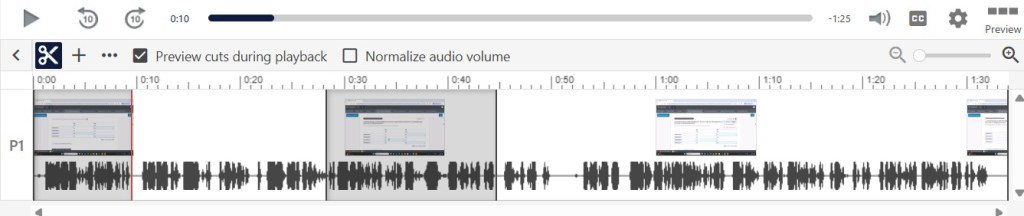
On the video timeline, use the left mouse button to click and drag to select sections of the video you want to remove. Edits can be made at any point within the video timeline.

Screenshot of the video timeline with selections of cuts which need to be made.

You can then play the video and the edited sections (shown in grey above) will not be included in your video.

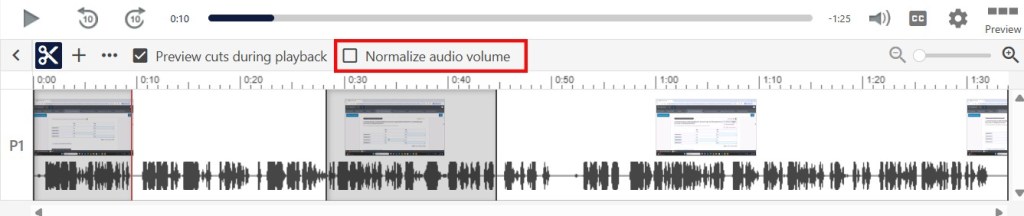
You can also normalize the volume levels across your audio. This increases the volume of the quieter sections of audio without clipping, making the entire audio track clearer. 

'Normalize audio volume' selection option highlighted.

Once you are happy you can click on the ‘Apply’ button at the top of the page.

Blue Apply button shown (alongside  other icon options at the top of the page).

For further information about editing in Panopto, please visit the TEL Panopto webpages: Staff Panopto Manual: Editing

Editing your video recordings in Panopto Read More »

Boost Engagement and Add Interactivity to Your Teaching with Vevox

Icons for: user engagement, reward, achievement, motivation, learning and challenge.

Research shows gamification can genuinely support learning. Dichev and Dicheva’s (2017)  Gamifying Education PDF  highlighted how small, game-like elements such as quick feedback, progress cues and low-stakes challenges can encourage greater student participation. A recent 2024 meta-analysis by Diaz and Estoque-Loñez reviewed 15 studies and found consistent improvements in learning achievement when gamified approaches were used (Meta Analysis PDF); reinforcing that well-designed, gamified strategies can have broad benefits. 

Want to try it? 

Vevox, the University’s live polling and Q&A tool, is running short, practical training sessions throughout January and February to help you get started. 

What you’ll learn 

  • How to run polling, plus an overview of Q&A and Surveys 
  • A walkthrough of the PowerPoint add-in, letting you run polls directly from your slides 
  • Practical ideas you can use straight away to build interaction and check understanding 

Sessions run weekly at a range of times, so you can choose whatever works around your timetable.

You can register for the webinar by clicking this link: registration link

Boost Engagement and Add Interactivity to Your Teaching with Vevox Read More »

Increase Engagement with Vevox Polls

Did you know the University of Worcester has a Vevox licence? If you haven’t tried it yet, now’s a great time to explore how it can help increase engagement in your teaching.

What is Vevox?

Vevox is a live polling and Q&A tool that works on any device. Students can answer polls, submit questions, vote in word clouds, or take part in quizzes – all in real time. It’s a quick way to make sessions more interactive, and it gives everyone a voice, not just the confident few.

How could you use it in your teaching?

  • Start with a quick poll to check prior knowledge.
  • Use quizzes mid-session to see if students are following along.
  • Run word clouds to capture key themes or opinions.
  • Open up anonymous Q&A so students can ask what’s really on their minds.
  • Gather feedback at the end of a class to shape your next session.

How to access Vevox

Staff can access Vevox via the Staff Webpage > Academic Resources. It’s straightforward to log in and start creating polls, quizzes, or Q&A sessions for your students.

Want to find out more?

Vevox are running a free webinar on Thursday 6th November. The session will explore practical strategies for engaging large cohorts, fostering interaction in lectures, and maximising engagement in flipped classes

👉 Register for the webinar here

Increase Engagement with Vevox Polls Read More »

September Support from TEL

As the first semester gets underway and new colleagues join the university, we thought it would be helpful to signpost where and how staff can access support from the Technology Enhanced Learning (TEL) Unit. Whether you’re exploring new digital tools or seeking guidance on best practices for online learning, we’re here to assist.

Online Support Resources

  • Our TEL Tools page provides an overview for staff of the main technologies used to support learning, teaching and assessment at the university.
  • Our Support Resources page links to a range of online guides, manuals and instructional videos for both staff and students. You will be able to find support for the Blackboard VLE (including Class Collaborate), Turnitin, PebblePad and Panopto. You can share suitable links from our student support pages with your students. For example, you can choose to include the most appropriate student resources within your module content: Adding Links

Our TEL Blog:

Staff members are welcome to subscribe to our Blog posts. These keep staff updated about recent changes to the VLE and its’ integrations and also provide handy hints or tips for using our suite of Learning Technologies. We have included some blog highlights below, from last year, which are helpful to refer to early on in a semester:

Additional help and training:

We run staff training sessions through the year. Our workshops are included in Staff Development / iTrent bookings. In addition, our team of Learning Technologists are available for departmental or small group training sessions for staff. So, if you or your colleagues have any Learning Technology training needs, please do get in touch. Also, if you have any questions or queries about the systems we manage, please contact us at TEL tel@worc.ac.uk.

September Support from TEL Read More »

Knowledge Checks in Blackboard

Document on a computer screen showing two ticks and one cross next to lines of text - like a multiple choice quiz
Adobe stock by Belozersky

Knowledge checks are an element of interactive learning, which tutors can weave into their module content as an informal form of assessment, providing immediate feedback for students.

The knowledge check block can be included in a Blackboard document as an engagement tool. Tutors can pose multiple choice or multiple answer questions, and tailor their feedback for correct / incorrect answers. Knowledge checks permit unlimited attempts for students and lecturers will have access to useful metrics to review levels of understanding.

How are knowledge checks beneficial to learning?

Knowledge checks can be used:

  • To assist with students’ acquisition and retention of key knowledge.
  • To help students identify learning aspects which they need to delve into further.
  • To improve levels of engagement with module content.
  • As an approach to boost students’ confidence.

Multiple attempts are permitted for these brief informal quizzes, so this will hopefully reduce the pressure for students to get everything correct the first time. Academic staff can tailor the feedback for both correct and incorrect answers, this allows tutors to encourage their students and add additional clarification. Feedback can be used to reveal an explanation, to reduce the chance of common misconceptions forming.

How can I use the metrics?

Knowledge check metrics can be helpful for lecturers to determine any knowledge or understanding blind spots their students may have as a group. Results can be used to inform additional teaching activities, providing their students with the opportunity to tackle gaps in their knowledge. The metrics are only visible for tutors and give a general overview of question attempts. Unlike Blackboard tests, the results are not included in the Gradebook alongside names (so it is not possible to track individual interactions), but a summary is displayed in the original document for instructors, where the knowledge check quiz was added.

Where can I add knowledge checks within module contents?

These multiple-choice quizzes can be added to a document at any point within a module, allowing flexibility in approach. For example:

  • Knowledge checks could be used to reflect on pre-existing knowledge when starting off a new topic.
  • They can be included for students to engage with or review new information contained in the same document.
  • Provide a quick review or discussion prompt mid-way through a module.
  • Or as a short informal revision task, for students to check their levels of understanding at the end of the module for core concepts.

Please see our guidance about how to add Knowledge Checks here.

Blackboard also have useful information about the features of knowledge checks in their online guidance and video.

Knowledge Checks in Blackboard Read More »

Reflections and Review – Blackboard Ultra Insights Week

Adobe stock by adrian_ilie825

The Technology Enhanced Learning Unit’s Blackboard Ultra Insights Week proved to be a resounding success, drawing in enthusiastic participation across all sessions. By shifting from a full-day in-person event to several shorter, focused online sessions spread throughout the week, the format offered a more accessible and flexible experience for attendees. We had some people who attended every session and others who dipped into those sessions that were especially relevant to their interests.

The sessions covered a range of topics around engagement and retention in Blackboard Ultra:

  • Integrating Reading Resources covered methods to help students engage with course readings, including a demonstration by Michelle Sterry of her use of reflective journals for students to record and receive feedback on their readings
  • Engagement and Analytics covered Helen Watts’ research into VLE engagement as an indicator of student outcomes and Helen Hope’s use of Blackboard analytics to facilitate student engagement.
  • Guided In-class Activities showcased Louise Martin’s innovative use of Blackboard functionality to build tasks for students to work through in a classroom setting. One attendee said it was “The most useful thing I have seen in ages!”
  • Building Fully Online Courses looked at Sarah Davis’s development of a fully online master’s-level course using a combination of Blackboard Ultra and MS Teams. Sarah’s approach would be an excellent blueprint for anyone considering adopting a distance-learning approach, so we highly recommend viewing the recording if this applies to you.

Recordings are now available on the LDTE CPD SharePoint site at the link below:

LDTE CPD – Home

Thanks again to Ros Sykes, Michelle Sterry, Helen Watts, Helen Hope, Louise Martin and Sarah Davis for presenting some fantastic sessions, and to everyone who attended.

Reflections and Review – Blackboard Ultra Insights Week Read More »

Blackboard Ultra Insights Week – Drop in Sessions

Group of People in an Online chat - displayed on a laptop screen

Adobe stock by Triative

As part of Blackboard Ultra Insights Week, the TEL team will be hosting some online drop-in sessions open to all staff. These will offer support and ideas on enhancing course engagement and interactivity, improving course structure, and copying content effectively for the new academic year. Come along and chat to us, bounce some ideas around or ask any questions that you may have.

Drop-in sessions:

Tuesday 20th May, 14:30pm -15:30

Link to join the session

Friday 23rd May, 10:00 – 11:00

Link to join the session

Additionally, as part of the week’s events, staff are invited to participate in a quick survey about Ultra – just three questions that will help us identify what tools are most useful to staff.

You can access the survey here.

Blackboard Ultra Insights Week – Drop in Sessions Read More »

Blackboard Ultra Insights Week

Red person-shaped wooden game piece in centre - with a network of other people shaped pieces around them.
Adobe stock by Monster Ztudio

The Technology Enhanced Learning Unit is celebrating the successful first year of the University using the new Blackboard Ultra VLE with a Blackboard Ultra Insights Week. Throughout the week, online presentations will be delivered by colleagues from academic faculties, Library Services, and the TEL team, showcasing innovative and effective uses of Blackboard Ultra. Sessions have been scheduled around lunchtime, offering a timely break and a chance to engage with something different during the marking period. The presentations will be recorded for those who are unable to attend.

In addition, the TEL team will host online drop-in sessions open to all—offering support and ideas on enhancing course engagement and interactivity, improving course structure, and copying content effectively for the new academic year.

There will also be an opportunity to take part in an online survey designed to gather insights into which areas and tools within the VLE staff find most valuable.

The itinerary for the week is as follows:

Staff Presentations:

Student Engagement with Module Readings

Monday 19th May, 11:00 – 12:00

Ros Sykes, Andrew Bright, Michelle Sterry

This session will explore strategies to boost student engagement with course literature and resources, focusing on practical techniques in Blackboard to encourage the use of your Talis resource lists.

VLE Engagement and Course Analytics

Tuesday 20th May, 12:00 – 12:45

Helen Watts, Helen Hope

This session will look at VLE engagement and student retention, and the practical use of Blackboard Ultra’s analytic tools.

Guided in-class Activities in Blackboard Ultra

Wednesday 21st May, 12:30 – 13:30

Louise Martin

In this session, Louise Martin will demonstrate how guided activities in Blackboard Ultra can be used to support in-class learning, showcasing interactive tasks she has designed to actively engage students and reinforce key concepts.

Developing Fully Online Courses

Thursday 22nd May, 12:00 – 13:00

Sarah Davis

In this session, Sarah Davis will share her experience of developing a fully online course using Blackboard. This session is ideal for anyone considering the design of fully online or highly blended courses—an area of growing strategic importance for the University.

Drop-in sessions:

  • Tuesday 20th May, 14:30 -15:30
  • Friday 23rd May, 10:00 – 11:00

Links for all presentations and drop-in sessions will be shared at a later date.

We hope that you will be able to take part!

Blackboard Ultra Insights Week Read More »