Microsoft Teams now available in Blackboard Ultra

We’re excited to announce the launch of a new integration that brings Microsoft Teams directly into Blackboard Ultra. This means staff and students can now access Teams meetings and collaboration spaces without leaving the Ultra environment.

The integration offers a familiar interface for many users, with the added benefit of streamlined scheduling and access to Teams meetings from within Ultra modules.

Beyond usability, this offers the potential opportunity to replace Collaborate with a more robust, widely supported platform for online learning, which is already included in the university’s Microsoft 365 licence.

There was an introductory session with Justine Walker and Darren Cooper on the 4th December. This outlined the basic use of Teams through Blackboard, and included discussions around teaching and learning applications. Please see a link to the recording of the session below:

LDTE Connect & Deliver Teams Integration Essentials with Blackboard.mp4

Other support resources and guidance for using Teams in Ultra are available in our Blackboard manual:

https://lttu.uk/support/Blackboard/UltraManual/teams-meetings

If you have any further queries, please feel free to contact us at tel@worc.ac.uk

Digital Services also offers a variety of resources on the IT Service website to assist users in using Microsoft Teams. The Microsoft Teams – Guide Page, Microsoft Teams – Training Page, and Microsoft Teams – FAQ Pages provide comprehensive guides, training materials, and general information regarding Microsoft Teams.

Additionally, Digital Services is planning to launch a ‘Making the most of Microsoft Teams’ workshop, which will cover all features and options available in team meetings. These workshops will appear in the iTrent training page.

Microsoft Teams now available in Blackboard Ultra Read More »

Gerry Beattie’s Retirement

After three decades of dedicated service to the University of Worcester, Gerry Beattie will be retiring from his role as Academic Learning Technologist at the end of this Semester. Gerry has been a cornerstone of the Technology Enhanced Learning Unit, known throughout the University for his expertise in video production for multimedia projects and assessments.

His retirement marks the end of an era, and we will miss him enormously.


Looking Ahead: A New Approach to Video Support

As we move forward, we want to be transparent about how video support will evolve. Gerry’s role will not be replaced like-for-like. Instead, we are shifting towards a more self-service model using tools such as Panopto, which is available to all staff and students for recording and sharing video content.

For assessment recordings, we encourage colleagues to explore Panopto’s capabilities, which is the University’s primary tool for video assessment and video management. This is now used by the majority of the University for video presentations

For projects, we will continue to offer limited video support, including basic filming and editing.

We understand this is a significant change, and we’re here to support you through it. Guidance and training on using Panopto effectively will be available, and we welcome feedback as we adapt to this new model.

Gerry Beattie’s Retirement Read More »

From Feedback to Best Practice: Designing Blackboard Ultra Modules that Work for Students

Book and pencils with colourful background

A new online resource is now available to support staff in designing engaging and effective Blackboard Ultra modules. It draws on research exploring students’ expectations and experiences of the Virtual Learning Environment (VLE), bringing together key insights and practical strategies for effective VLE design.

As part of the Postgraduate Certificate in Learning and Teaching in Higher Education, I explored students’ perceptions of Blackboard Ultra and its role in supporting learning.

The findings from this research have been developed into an online resource that highlights key principles of good course design and offers practical strategies that colleagues can apply to enhance their Blackboard Ultra modules. The resource is structured around six student-informed themes, covering areas such as clear structure and navigation, flexible and accessible content, effective communication, and active engagement. Each theme provides actionable guidance that can be implemented within individual modules or across wider course teams.

The aim of this resource is to support colleagues in reflecting on their current modules and identifying opportunities to build on existing good practice to further enhance the student experience.

👉 You can explore the full resource here.

If you would like support in reviewing your Blackboard modules, implementing these approaches, or simply discussing how these principles might apply to your teaching, please get in touch. You can contact me directly: Nisha Atkins – n.atkins@worc.ac.uk, or reach out via the TEL Team at TEL@worc.ac.uk. We are happy to support you individually or as part of a course team.

From Feedback to Best Practice: Designing Blackboard Ultra Modules that Work for Students Read More »

Digital Wellbeing in the “Always On Classroom”

Person in crossed legged yoga pose on a desk top, with a laptop next to them.

As the nights draw in and the days get shorter, it is a good time to consider your digital wellbeing. Online and hybrid teaching has blurred boundaries between work and home – classrooms now stretch into kitchens, buses, and home offices. But being constantly connected doesn’t make us more effective. For staff and students, an “always-on” approach can quietly drain focus, energy, and wellbeing. UK research shows students can experience increased ‘technostress’ linked to messaging and app use in learning contexts ( Biggins & Holley, 2023 https://eprints.bournemouth.ac.uk/37700/).

Even short digital tasks can become overwhelming. Some common challenges include:

· Frequent notifications from Teams, email, or Blackboard.

· Switching between apps and tabs, which reduces focus (Lister et al., 2022: https://oro.open.ac.uk/84158/).

· Feeling the need to be available at all times.

Set Some Boundaries

Academic work can easily blur into personal time. Setting clear expectations helps model healthy digital habits:

· Add a note to your module: “I check discussion boards weekdays 09:00–17:00. Responses may take 24 hours.”

· Use Teams/Outlook quiet hours and tell students you do – it normalises offline time.

· Turn off push notifications after hours; your brain will thank you.

Design for Digital Calm

A cluttered digital space can feel as stressful as a messy desk.

· Keep navigation simple and avoid too many layers of folders and subfolders.

· Limit announcements and emails to essential information only.

· Hide old modules on your Blackboard dashboard to reduce “digital noise.”.

· Make content accessible: uAlt-text, captions, and consistent layouts help everyone (Lister et al., 2022: https://oro.open.ac.uk/84158/).

Connecting to the Bigger Picture

Jisc’s Digital Wellbeing for You, Your Colleagues and Learners (2024) reminds us that digital wellbeing isn’t just about screen time, it’s about creating environments where technology supports rather than overwhelms. Their guidance encourages staff to build in moments of digital calm by simplifying online spaces, supporting balance, and modelling positive digital habits. You can explore the full guide here: Jisc Digital Wellbeing for You, Your Colleagues and Learners (PDF)

Top Tips for Digital Wellbeing

(Based on Jisc’s 2024 Practitioner Guidance)

Be intentional – Pause before you click. Choose tech and tools that serve your purpose, not the other way round.

Set boundaries – Ditch the “always-on” culture. Turn off notifications and protect offline time.

Mind your body and mind – Take screen breaks, move regularly, use blue-light filters, and notice when tech is draining rather than supporting you.

Shape your digital self – Review your online profiles and platforms. Make sure they reflect the professional (and person) you want to be.

Share the load – Digital wellbeing is a team effort. Talk openly with colleagues and students about healthy digital habits.

Digital Wellbeing in the “Always On Classroom” Read More »

New PebblePad Atlas Interface

PebblePad Logo 2025

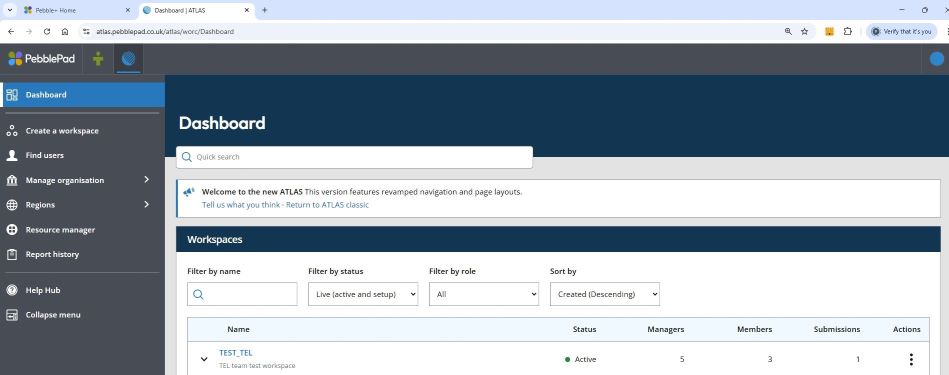
If you are a tutor who assesses student work via PebblePad, you will be pleased to hear that there is a new ATLAS interface that is scheduled to be released in early January 2026. The new ATLAS design is a significant improvement in terms of visual appearance and workflow. The intention is to provide a clearer layout that requires less clicks to complete your tasks.

PebblePad new Atlas Dashboard

To assist you in preparing for this change, we can provide you with the option to toggle into the new ATLAS view. If you find that you want to revert to the original view, you can toggle back again until the end of December.

PebblePad Toggle button - Preview the new Atlas - Try the new ATLAS

If you would like to have this toggle option added to your ATLAS account to familiarise yourself with the new layout, please email TEL@worc.ac.uk

New PebblePad Atlas Interface Read More »

Increase Engagement with Vevox Polls

Did you know the University of Worcester has a Vevox licence? If you haven’t tried it yet, now’s a great time to explore how it can help increase engagement in your teaching.

What is Vevox?

Vevox is a live polling and Q&A tool that works on any device. Students can answer polls, submit questions, vote in word clouds, or take part in quizzes – all in real time. It’s a quick way to make sessions more interactive, and it gives everyone a voice, not just the confident few.

How could you use it in your teaching?

  • Start with a quick poll to check prior knowledge.
  • Use quizzes mid-session to see if students are following along.
  • Run word clouds to capture key themes or opinions.
  • Open up anonymous Q&A so students can ask what’s really on their minds.
  • Gather feedback at the end of a class to shape your next session.

How to access Vevox

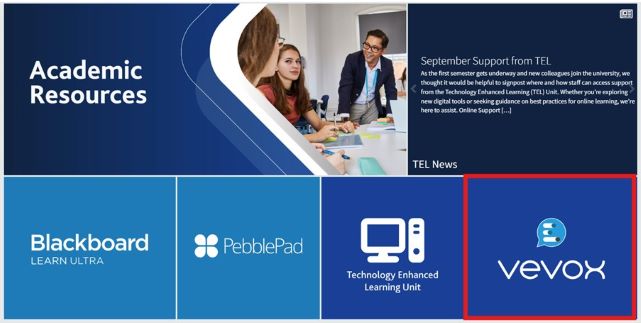
Staff can access Vevox via the Staff Webpage > Academic Resources. It’s straightforward to log in and start creating polls, quizzes, or Q&A sessions for your students.

Want to find out more?

Vevox are running a free webinar on Thursday 6th November. The session will explore practical strategies for engaging large cohorts, fostering interaction in lectures, and maximising engagement in flipped classes

👉 Register for the webinar here

Increase Engagement with Vevox Polls Read More »

September Support from TEL

As the first semester gets underway and new colleagues join the university, we thought it would be helpful to signpost where and how staff can access support from the Technology Enhanced Learning (TEL) Unit. Whether you’re exploring new digital tools or seeking guidance on best practices for online learning, we’re here to assist.

Online Support Resources

  • Our TEL Tools page provides an overview for staff of the main technologies used to support learning, teaching and assessment at the university.
  • Our Support Resources page links to a range of online guides, manuals and instructional videos for both staff and students. You will be able to find support for the Blackboard VLE (including Class Collaborate), Turnitin, PebblePad and Panopto. You can share suitable links from our student support pages with your students. For example, you can choose to include the most appropriate student resources within your module content: Adding Links

Our TEL Blog:

Staff members are welcome to subscribe to our Blog posts. These keep staff updated about recent changes to the VLE and its’ integrations and also provide handy hints or tips for using our suite of Learning Technologies. We have included some blog highlights below, from last year, which are helpful to refer to early on in a semester:

Additional help and training:

We run staff training sessions through the year. Our workshops are included in Staff Development / iTrent bookings. In addition, our team of Learning Technologists are available for departmental or small group training sessions for staff. So, if you or your colleagues have any Learning Technology training needs, please do get in touch. Also, if you have any questions or queries about the systems we manage, please contact us at TEL tel@worc.ac.uk.

September Support from TEL Read More »

Update on Turnitin Icons in Blackboard

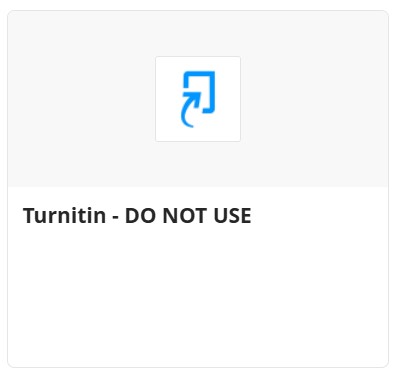
You may have noticed that a second Turnitin logo has recently appeared in the Content Market within Blackboard. This new icon is blue, in contrast to the original red and blue logo. We’ve been in contact with Turnitin to clarify its purpose, as both logos appear to be linked to our current LTI 1.3 integration.

While Turnitin has not provided a definitive explanation for the appearance of the second logo, they have advised us to continue using the original red and blue icon. This version is connected to historical submissions and ensures continuity across existing assessments. To avoid confusion, we have labelled the blue logo with a “Do Not Use” tag.

If you have already created submission points using the blue icon, please don’t worry—these will remain active and unaffected, and students will not notice any difference. However, moving forward, please ensure that all new Turnitin submission points are created using the red and blue logo.

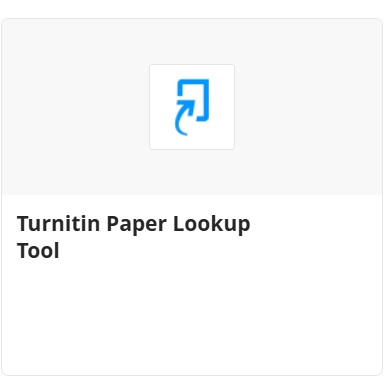
Additionally, you may see a new tool called the Turnitin Paper Lookup Tool. This feature is designed to help you access historical submissions more easily. We will share further guidance on how to use this tool in due course.

Update on Turnitin Icons in Blackboard Read More »

New Recommended Panopto Assignment Process

We have listened carefully to feedback from both staff and students regarding Panopto assignment submissions, particularly around challenges with the submission process. In summary, the main issues raised are:

  • The submission process is not always straightforward, and some students struggle to complete it successfully.
  • The student experience varies across devices, with MacBook users finding the process particularly difficult and encountering limitations in available features.
  • The existence of multiple submission routes can create confusion.

In response, we have reviewed the situation and decided to standardise the recommended process so that all Panopto submissions follow one clear, simple workflow. This approach is designed to ensure consistency and ease of use for all students, regardless of the device they are using.

Going forward, we recommend that video submissions are created as a PowerPoint presentation with Cameo voiceover, saved as an MP4, and then uploaded to Panopto. This method is more straightforward and relies on familiar tools, making it far simpler than Panopto’s browser capture. PowerPoint is a tool that is available to all students as part of the free Office 365 subscription through the University. Should you as the course tutor wish to stipulate a different method of video creation, such as using Camtasia, this is your choice. The main point is that the video should be created first and then submitted.

While this workflow has always been an available option — particularly for students experiencing difficulties — some tutors have raised concerns about academic integrity. To address this, we consulted with the University’s Academic Integrity Tutors, who have confirmed that this process fully meets academic integrity requirements.

Please read the guidance on using Panopto with PowerPoint.

To set up a Panopto Video submission, please follow the guide. This part of the process will be unchanged from last year.

If you have any questions, please email me at a.bright@worc.ac.uk

Andrew Bright

Interim Head of Technology Enhanced Learning

New Recommended Panopto Assignment Process Read More »

Turnitin Originality Reports in Blackboard Assignments

It is now possible to generate Turnitin originality reports for standard Blackboard assignments. This allows staff and students to view originality matches directly within Blackboard while still using the standard Blackboard grading and feedback tools. (Turnitin Feedback Studio for grading is not currently supported). This may be useful if you would like to have one submission point for marking with Blackboard but need a Turnitin originality check, or track multiple attempts.

It is easy to enable this new functionality with your Blackboard assignments.

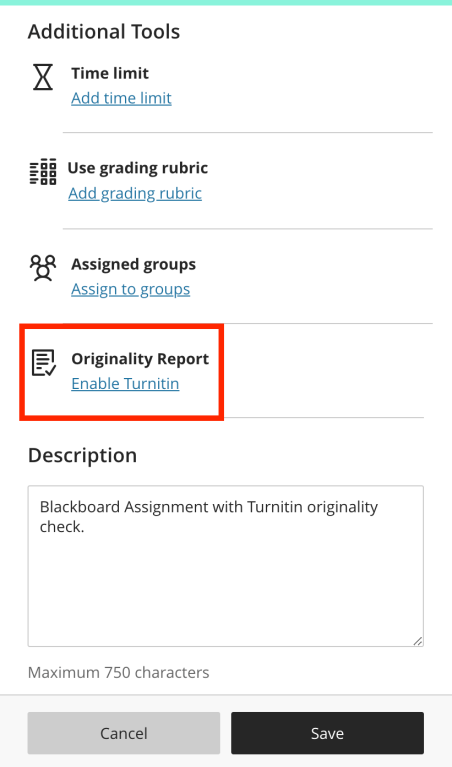
To do this, when setting up a new assignment, in the Additional Tools section, click the Enable Turnitin option:

'Enable Turnitin' option shown in red box, within the Blackboard menu options

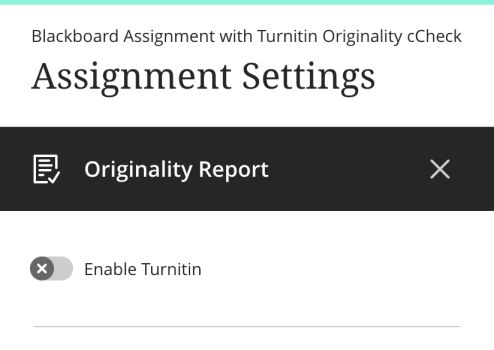
The integration will load, and you can then toggle the Enable Turnitin switch to the On position.

'Enable Turnitin' sliding toggle button shown below Originality Report in the Assignment Settings.

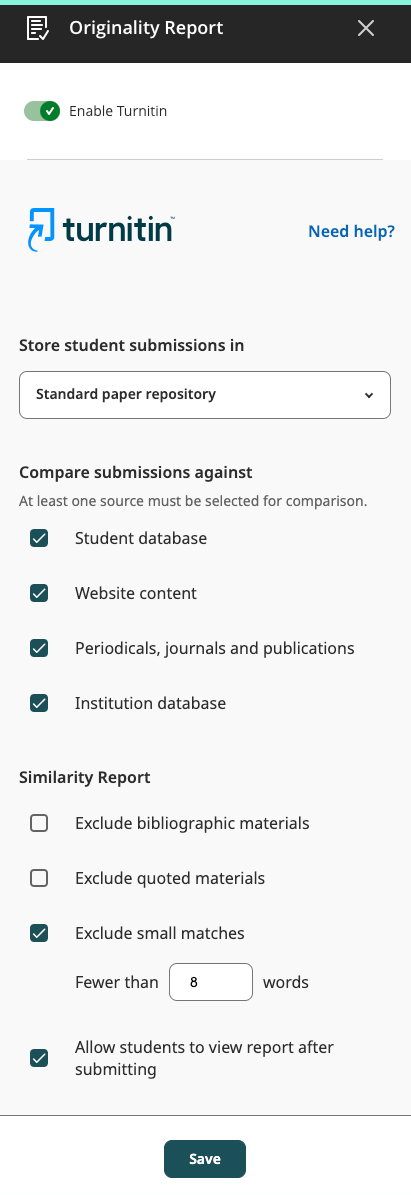
Select your Turnitin options as usual. Choose the Standard Paper Repository for summative work, or Do not store the submitted papers for formative. Select sources to check, and select the Similarity Report options as needed. Finally, click the Save button to finalise these settings. You can always return to these settings to update later if required.

Originality Report Menu settings are shown - displaying the different tick box options which are available.

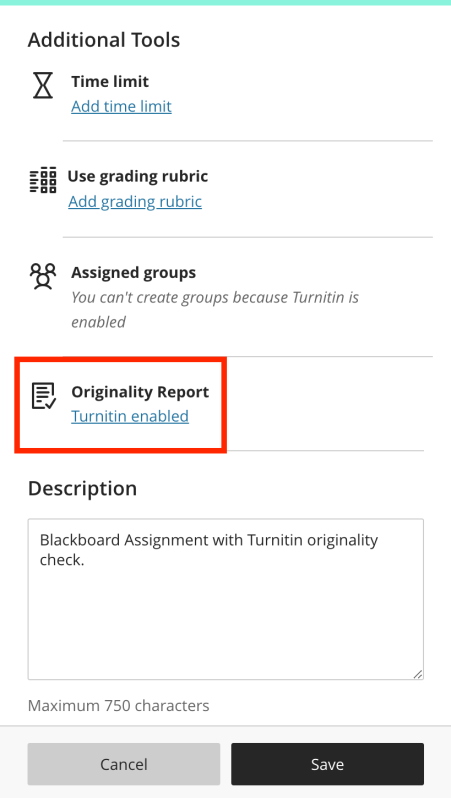
When you return to the Additional Tools section in the Assignment Settings, you should see that Turnitin has been enabled:

Image of 'Turnitin enabled' to show how this looks when turned on and the 'Save' button to apply the chosen Turnitin settings.

Once papers have been submitted and processing is complete, staff and students will be able to view the originality report by clicking on the originality percentage button:

An example of an assignment with the 'originality percentage button' highlighted in a box, in the top right-hand corner.

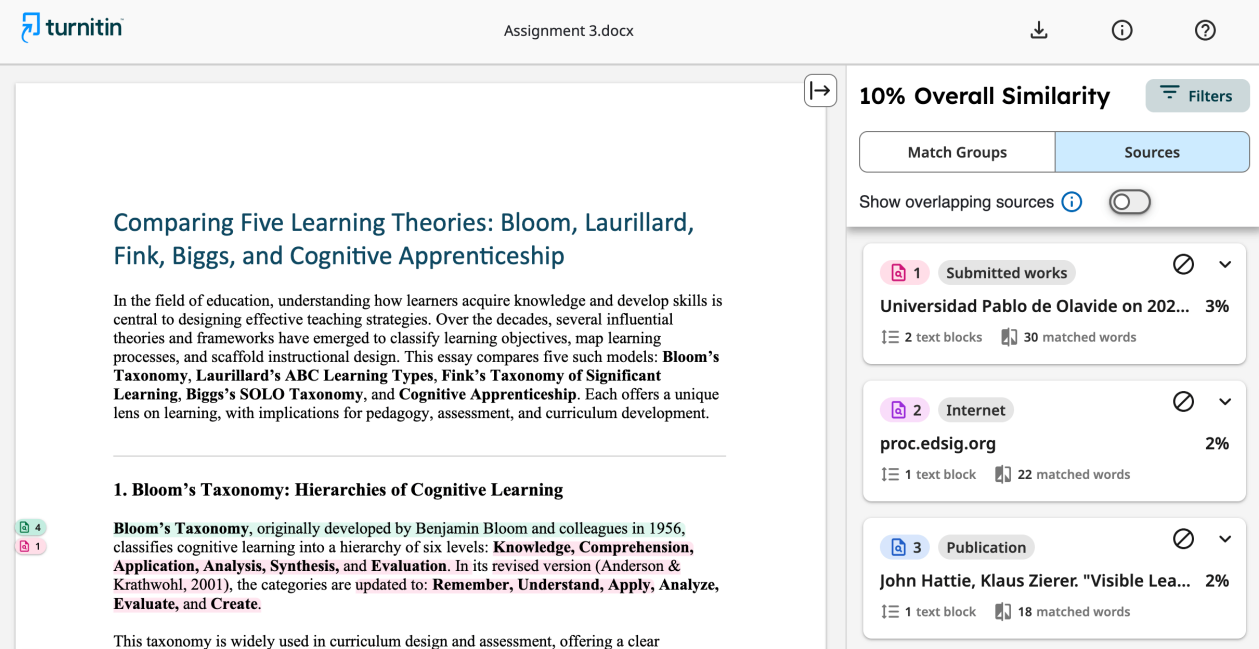
The Originality report will then load in a new tab using the updated Turnitin interface:

Example of an originality report using the updated Turnitin interface. The assignment appears on the left hand side. Then the 'sources' / similarity matches are in a column on the right hand side of the page. A 'filters' option is at the top of the sources list.

Turnitin Originality Reports in Blackboard Assignments Read More »